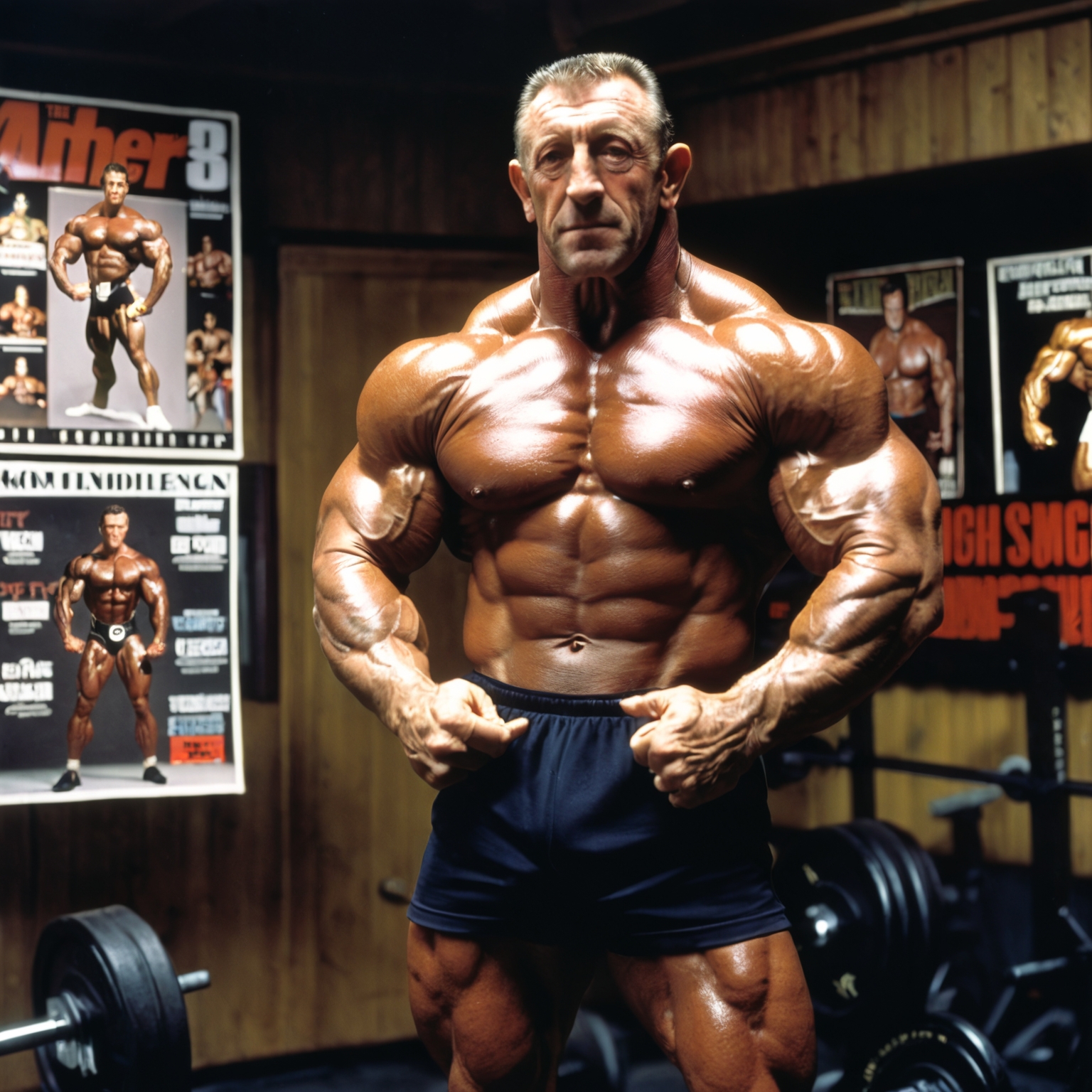
Dorian Yates: The Training Philosophy That Changed Bodybuilding Forever
Dorian Yates won six consecutive Mr. Olympia titles between 1992 and 1997 and in doing so changed what professional bodybuilding looked like and how serious lifters thought about training. He brought a level of mass and conditioning that had never been seen before on the Olympia stage, and he did it with a training approach that was the opposite of what most people were doing at the time. While others were grinding through high-volume routines with dozens of sets per muscle group, Yates was training with brutal intensity for comparatively short sessions and building one of the most dominant physiques in the history of the sport.
His methods were controversial when he introduced them and remain influential today. Understanding what he actually did, why he did it, and what separates his approach from standard training advice gives serious lifters a framework for thinking about intensity, volume, and recovery that goes beyond generic programming.
The Shadow: Background and Rise
Dorian Yates grew up in Birmingham, England, a working-class city in the British Midlands. He discovered lifting in his late teens and became obsessed with it in a way that few people match. While American bodybuilding culture in the 1980s was centered in California around Gold’s Gym and the high-visibility social scene around training, Yates trained alone in a basement gym in Birmingham called Temple Gym and refused to compete at the Olympia until he believed he was ready to win.
His isolation from the mainstream bodybuilding circuit contributed to his mystique. He would send videotapes of his conditioning to judges and observers rather than making the social rounds, and when he finally appeared on the Olympia stage he arrived with a physique that shocked the field. He earned the nickname The Shadow because of how rarely he was seen and how suddenly he appeared to dominate.
High-Intensity Training: The Core of the Yates Method
Yates built his training philosophy around the principles of Arthur Jones and Mike Mentzer, who advocated for high-intensity, low-volume training as an alternative to the high-volume approaches popularized by Arnold Schwarzenegger and the old-school California bodybuilding scene. The core premise is that muscular growth is triggered by intensity of effort, not by the total volume of work, and that training to or beyond momentary muscular failure produces a stronger growth stimulus than performing many sets at submaximal effort.
Where most bodybuilders were performing 15 to 20 sets per muscle group in a session, Yates might perform 6 to 9 working sets total for a major muscle group, but every one of those sets was taken to absolute failure and often beyond through forced reps or rest-pause techniques. The sessions were shorter but significantly more demanding in terms of effort-per-set than standard bodybuilding training.
The Blood and Guts Training Methodology
Yates laid out his approach in his book and video series titled Blood and Guts. The key principles are straightforward. Each muscle group is trained once per week with maximum intensity. Before the working sets, one or two progressively heavier warm-up sets prepare the joints and establish positioning. The working set or sets are performed to absolute failure, meaning the point at which no additional reps can be completed with correct form without external assistance.
After reaching failure, Yates often continued the set using forced reps, where a training partner provides just enough assistance to allow two or three additional repetitions beyond the point of independent failure. The combination of reaching failure and then extending the set past that point creates an overload stimulus that Yates argued was the primary driver of the extreme muscle development he achieved. Research indexed on PubMed examining training to failure confirms that sets taken to or near failure produce greater hypertrophic stimulus per set than those stopped well short, supporting the theoretical basis of this approach.
Training Split and Weekly Structure
Yates trained four days per week with three days of rest distributed between sessions. His standard split: Day 1 trained chest, biceps, and triceps. Day 2 trained back and rear deltoids. Day 3 was rest. Day 4 trained shoulders, biceps, and triceps (with emphasis on triceps). Day 5 trained legs. Days 6 and 7 were rest. This four-on, three-off structure allowed his high-intensity approach to be applied without accumulated fatigue compromising session quality.
The relatively infrequent training frequency per muscle group was intentional. Yates argued that muscles trained to absolute failure require more recovery time than muscles trained at submaximal effort, and that returning to train a muscle group before it has fully recovered does more harm than good. This recovery emphasis was ahead of its time and aligns with current understanding of muscle protein synthesis timelines following high-intensity resistance training.
Exercises That Defined His Training
Yates made the Yates row famous, a barbell row variation performed with a slight forward lean rather than the parallel-to-floor position of a strict bent-over row. The reduced forward lean reduces lower back stress while still hitting the lats and mid-back with heavy loading. It allows more weight to be used safely than a strict pendlay row and has become a widely used back exercise in its own right.
He also prioritized machine and cable work for certain movements, particularly in the latter portion of his career when he was managing chronic joint injuries from years of extreme loading. His willingness to use machines without apology helped legitimize machine training in a culture that heavily favored free weights as the only serious option. Protecting your joints for long-term training is something Yates learned the hard way. Investing in quality support gear like elbow sleeves and a solid lifting belt reflects the same hard-earned wisdom.
Injuries and the Dark Side of Extreme Training
Yates suffered serious injuries throughout his competitive career and these ultimately contributed to his retirement. He tore his left bicep in 1994 during the weeks before the Olympia and competed and won anyway. He tore his right tricep in 1996 and again competed and won. In 1997 he tore his left tricep just before the Olympia, competed for the sixth consecutive title, won, and then announced his retirement. These injuries were at least partially the consequence of training at extreme intensities with very heavy weights over many years.
The lesson most serious lifters take from this is not that high-intensity training is inherently dangerous but that extreme loading demands exceptional joint health, excellent technique, thorough warm-ups, and a willingness to manage volume carefully as training age and loading history accumulate. The intensity principles Yates championed are sound. Applying them without regard for joint preparation and recovery is where the risk concentrates.
Legacy and Influence on Modern Training
Yates’s influence on training culture was enormous. His success made high-intensity, low-volume training a legitimate alternative to the dominant high-volume approaches of the time and opened a productive debate about the dose-response relationship between training volume and muscle growth that is still active in exercise science today. Modern concepts like effective reps, proximity to failure as a training variable, and minimum effective dose for hypertrophy all trace intellectual ancestry back through Mike Mentzer and Arthur Jones to the principles Yates embodied in his competitive career.
Even among lifters who do not follow his exact methods, the influence shows up in how seriously the fitness community now takes the concept of effort quality over quantity. Six hard sets taken to genuine failure accomplish more than twenty sets performed with effort held well in reserve. That idea, which Yates lived out more completely than almost anyone in the history of the sport, changed how a generation of lifters approached their training.
FINAL WORDS
Dorian Yates was not just a bodybuilder. He was a philosopher of effort who built one of the most dominant competitive physiques ever seen by applying a clear, logical framework about intensity, recovery, and progressive overload with relentless consistency over years. Whether you adopt his exact methods or not, the principles behind them are worth understanding. Train with genuine effort, recover completely, and build on that cycle without shortcuts. That approach produces results in every era and every sport.
Certified strength and conditioning specialists with over 10 years of experience in powerlifting, nutrition, and evidence-based fitness content. Based in New York City.